
White County Release Date Meaning
A projected release date is a working calculation based on the sentence, credit, and release rules that apply at that time. The actual date is when the custodian completes release or transfer. Those dates can match, but they need not. White County Jail, the Georgia Department of Corrections, and the State Board of Pardons and Paroles each control different parts of the process.
A person awaiting trial has no sentence-expiration date. Bond may permit release, a judge may issue an order, or another agency hold may keep the person confined. Someone serving a county sentence has a term set by the court, credit for time already served when applicable, and any earned time the custodian lawfully awards. A state prisoner has a GDC sentence computation and may also have parole or Performance Incentive Credit information.
Find White County Release Dates
Begin with custody type. The White County Jail is a county facility, not a state prison. GDC's search does not replace the Sheriff's Office for a local pretrial booking or short county stay. Conversely, the county jail cannot confirm a state prisoner's calculated discharge after transfer to GDC.
- Confirm whether the person is in White County Jail, GDC custody, federal custody, or another agency's facility.
- For a county detainee, ask the Sheriff's Office about bond, first appearance, court orders, holds, and any county sentence date.
- For a state prisoner, search GDC by name, GDC ID, or case number and record the status and date fields.
- Check the parole TPM tool when parole consideration applies, but treat a TPM as tentative.
- Review the sentencing court record and confirm any displayed date with the current custodian.
The full White County released inmate search helps when the current custodian is uncertain. Use the booking and court case to follow a person from the county jail into GDC or another agency rather than assuming an absent county record means community release.
White County Jail Date Sources
The White County Sheriff's Office is the direct source for a county jail date. Its current-inmate list is disabled online, so call 706-865-5177 or the inmate-services line at 706-219-7846. Ask whether the person is pretrial, serving a county sentence, held for another agency, or awaiting transfer. Each status produces a different answer to “when will they be released?”
The Jail Division says most warrant arrests without a pre-existing bond amount receive first appearance at 2 p.m., Monday through Friday. First appearance is an initial court review, not a guaranteed release time. The jail also asks users to allow up to three hours after arrest for booking and bond data to become available. Neither fact creates a projected date.
- Pretrial
- Held while the charge is pending, without a sentence-expiration date.
- Time served
- Credit or a sentence outcome tied to time already spent confined.
- Detainer
- A request or legal basis for another authority to hold or receive the person.
- Discharge
- Completion of the controlling custody or supervision term.
White County GDC Date Search
The GDC Find an Offender form is for adult state offenders. It accepts routes based on name, description, ID, or case number. Search with a GDC ID when available, then match name and case details. Record the current facility or status, sentence data, and any release, parole, maximum, or status date shown.
A GDC result showing current prison custody means the person has not been released to the community, even if they left White County Jail by transfer. A release, discharge, or parole status can show that state custody changed. No GDC result does not prove a White County arrest never occurred. Many local bookings never create a state offender record.
The manifest capture from the GDC Performance Incentive Credit page illustrates the state program that can affect an eligible prisoner's length of stay.
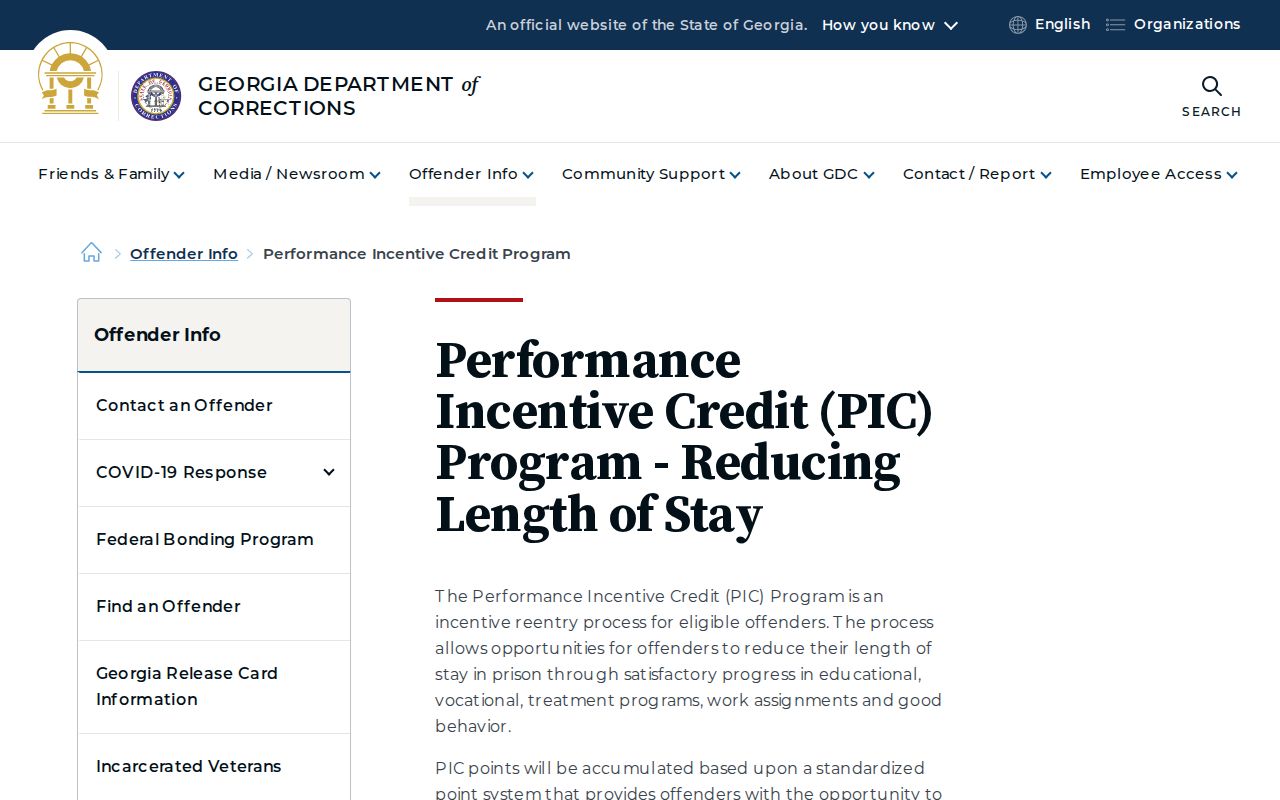
This state source applies to eligible GDC offenders, not to every person booked at the White County Jail.
White County Parole Date Layers
Georgia parole uses a Tentative Parole Month, or TPM. The Board of Pardons and Paroles explains that a TPM marks the month when final review is completed and, if appropriate, a parole release date is set. It is not a final grant. The Board may reconsider and change a decision before release, and a person eligible for consideration is not guaranteed parole.
The TPM lookup accepts a six-digit inmate number, GDC ID, or personal data. Non-life cases may result in a TPM, denial, reconsideration, or later final review. Life-sentence decisions generally use grant or deny rather than the same TPM path. Public monthly board meetings concern agency policy and operations; ordinary offender decisions are not courtroom-style public hearings.
The Georgia Parole TPM explanation is shown in the captured source below.
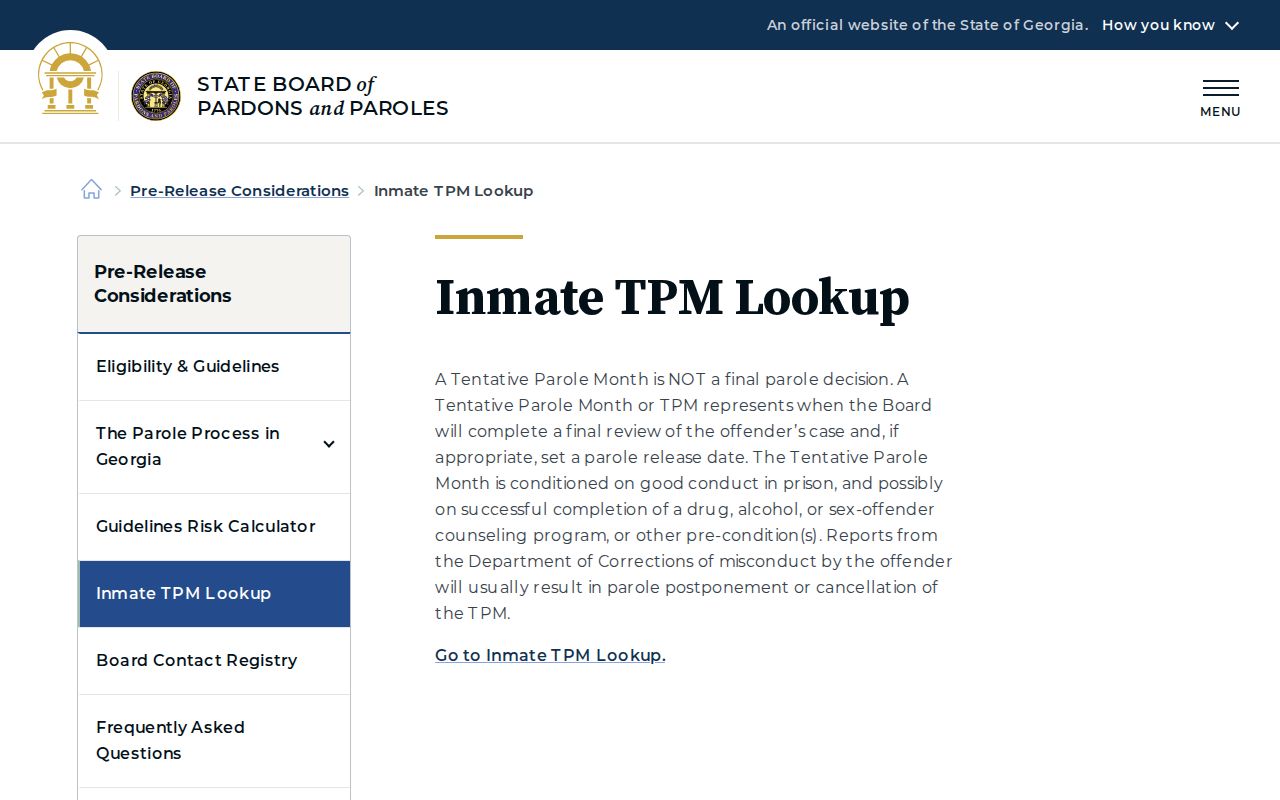
The TPM source must be read with the GDC status and sentence because it describes possible parole timing, not sentence expiration.
White County Earned-Time Rule
Georgia's county-inmate rule is distinct from state prison credit. O.C.G.A. § 42-4-7 permits a county custodian to award earned-time allowances based on institutional behavior. Release occurs at sentence expiration less allowed earned time. For modern county inmates, the allowance is not automatic or mandatory. The custodian's record, not a generic formula, shows whether credit was awarded.
This is White County's tagged release-date computation angle. A caller should ask for the sentence start, court-awarded credit, earned time actually posted, and current calculated end date. Do not subtract an assumed number of days from the sentence. A discipline issue, court correction, or hold can affect what happens even when a date appears in the jail record.
County earned time should not be confused with GDC PIC. O.C.G.A. § 42-5-101 authorizes work incentive credits tied to institutional achievements, work, and satisfactory behavior in the state system. GDC describes PIC as an incentive process for eligible offenders who make progress in education, vocational work, treatment, job assignments, and behavior.
White County Release Date Changes
Dates move for legal and administrative reasons. Some factors affect the sentence computation. Others do not alter the sentence but prevent release to the community. The record should identify which agency made the change and whether the result is a new date, a postponement, or a transfer.
| Factor | Possible effect |
|---|---|
| Earned credit or PIC | May reduce time for an eligible person when the custodian awards or applies it. |
| Misconduct | Can reduce eligibility, postpone a TPM, or cause loss of available credit under controlling rules. |
| Parole decision | A grant, denial, reconsideration, or final review can change expected state release timing. |
| Court order | A resentencing, correction, revocation, or other order can change the term. |
| Detainer or hold | May cause transfer or continued custody after the local or state term ends. |
| Required program | Failure to complete a parole or PIC precondition can delay the anticipated date. |
Georgia truth-in-sentencing rules also limit estimates. GDC reports that specified serious offenses can require 100 percent service without parole or good time under the applicable framework. Eligibility varies by conviction and sentence. Confirm the actual case under the parole statutes, including O.C.G.A. § 42-9-45, instead of applying a general percentage.
White County Court Date Records
The sentencing court supplies the legal term that the jail or GDC must compute. A White County docket may show the sentence, credit for time served, probation terms, revocation, amended orders, or later correction. For a person held before trial, the same file may show bond or a release order instead of a sentence end date. The White County Clerk of Court is the local source for these case records.
Compare the order with the custodian's current calculation. Courts impose sentences, but corrections agencies administer confinement and authorized credits. A docket date is not always the date a person physically leaves. Staff must receive the order, verify other holds, compute the term, and complete release or transfer. Ask for the booking or GDC identifier so the court case is matched to the right custody episode.
Probation is court-ordered supervision in the community and may follow jail or be imposed without prison. A probation end date is not the same as a jail release date. Revocation can return a person to custody and create a new computation based on the court's order.
White County Date Request Fields
When no public result explains the calculation, request only the records needed to trace it. For the county jail, ask for the sentence information held in the booking file, credit posted, earned time awarded, present calculated release date, and any hold or transfer note. For GDC, identify the offender by GDC ID and ask about the specific public date or sentence record that is unclear.
A useful answer separates four dates: arrest or booking, sentence start, projected or tentative release, and actual release. It should also identify whether the last event is discharge, parole, probation, or transfer. These terms are not interchangeable. Keeping them in order prevents a tentative parole month from being reported as a guaranteed day of release.
Confirm White County Actual Release
A date on a search result is only one part of confirmation. For White County Jail, call the Sheriff's Office and check the court order or sentence. For GDC, compare the offender record with parole information where relevant. If the person is moving to parole or felony probation in White County, the Department of Community Supervision's Dahlonega Field Office serves the county.
Georgia VINELink can add a custody-status alert when a participating agency supplies the record. Register while the person is still in custody. A later alert can signal release or transfer, but VINE is not the precise sentence computation or official release document. The White County VINELink release check explains the one-person search and notification process.
Federal and immigration custody require separate checks. BOP can display federal release data, while ICE has its own detainee locator. A release from White County to either authority ends the county stay but may continue confinement. Always request the destination on the local release entry.
Keep the confirmation date with the answer. A status checked today may change after a court order, parole review, credit update, or transfer. When timing matters, contact the current custodian again near the expected date and ask whether release authority is complete or whether another hold remains.