
White County Parole vs Probation
Parole and probation can both place a released person under Georgia Department of Community Supervision oversight, but they start in different ways. The Georgia State Board of Pardons and Paroles decides whether an eligible state prisoner receives parole. A White County court imposes probation as part of a sentence. A person may also serve a split sentence, with confinement followed by probation. The source of authority matters because the parole board record answers parole questions while the White County court file controls the terms of probation.
| Record type | How it begins | Best verification source |
|---|---|---|
| Parole | Board-authorized release from a GDC sentence | Georgia Parolee Search and parole board records |
| Felony probation | Sentence entered by a court | Sentencing court and DCS field office |
| Split sentence | Confinement followed by probation | Court disposition, GDC record, and DCS |
These records should not be confused with the White County Jail roster. The jail tracks local custody. It does not serve as a full list of people living in White County under parole or felony probation. Likewise, a parole result is not proof that a separate White County case has ended. Match the person's full name, birth details, primary offense, and case or offender number before treating two records as the same person.
- Parole
- Conditional community release during a state sentence, authorized by the parole board.
- Probation
- Court-ordered supervision in the community under stated terms.
- Discharge
- The formal end of a sentence or supervision term.
- Absconder
- A supervised person reported as no longer in contact with the assigned officer.
Verify White County Release Supervision
Begin with the custody path. Someone released from a GDC prison may have a parole record. Someone sentenced in White County may instead be on felony probation. The public Georgia Parolee Search can show a parole begin date, parole end date, assigned office, office number, and primary offense. A missing result calls for a check of the sentencing court and DCS, not a guess.
- Confirm the person's full legal name and, if available, GDC ID or White County case number.
- Search the Georgia Parolee Search. Compare identity details, offense, dates, and the listed parole office.
- If the person is still in state prison, use the Inmate TPM Lookup. A tentative parole month is not active supervision or a final release date.
- Check the White County sentencing record through the Clerk of Court when probation may apply.
- Contact the assigned DCS field office to verify reporting-office information or route an official records question.
The GDC offender search supplies state custody and sentence context. It is useful when the question is whether a person moved from prison to parole. For a county-jail-only stay, use the Sheriff's release record and court file instead. The full White County release path is summarized on the released inmates home page.
White County DCS Field Office
White County is served by the DCS Dahlonega Field Office. The office covers the Enotah Judicial Circuit and serves Lumpkin, Towns, Union, and White counties. Its regional role explains why a White County resident may be assigned to an office outside the county line. Always use the office shown in the current parole record or instructions from the supervising officer.
Georgia DCS Dahlonega Field Office163 Tipton Drive
Dahlonega, GA 30533
706-867-2929
The office can route supervision questions, but it does not replace the parole board for a parole decision or the White County court for a probation sentence. Have the person's identifying information and case or offender number ready. Staff may limit details when a record is not public or when identity cannot be confirmed.
The manifest-captured official Dahlonega office page shows the local service area and contact route.
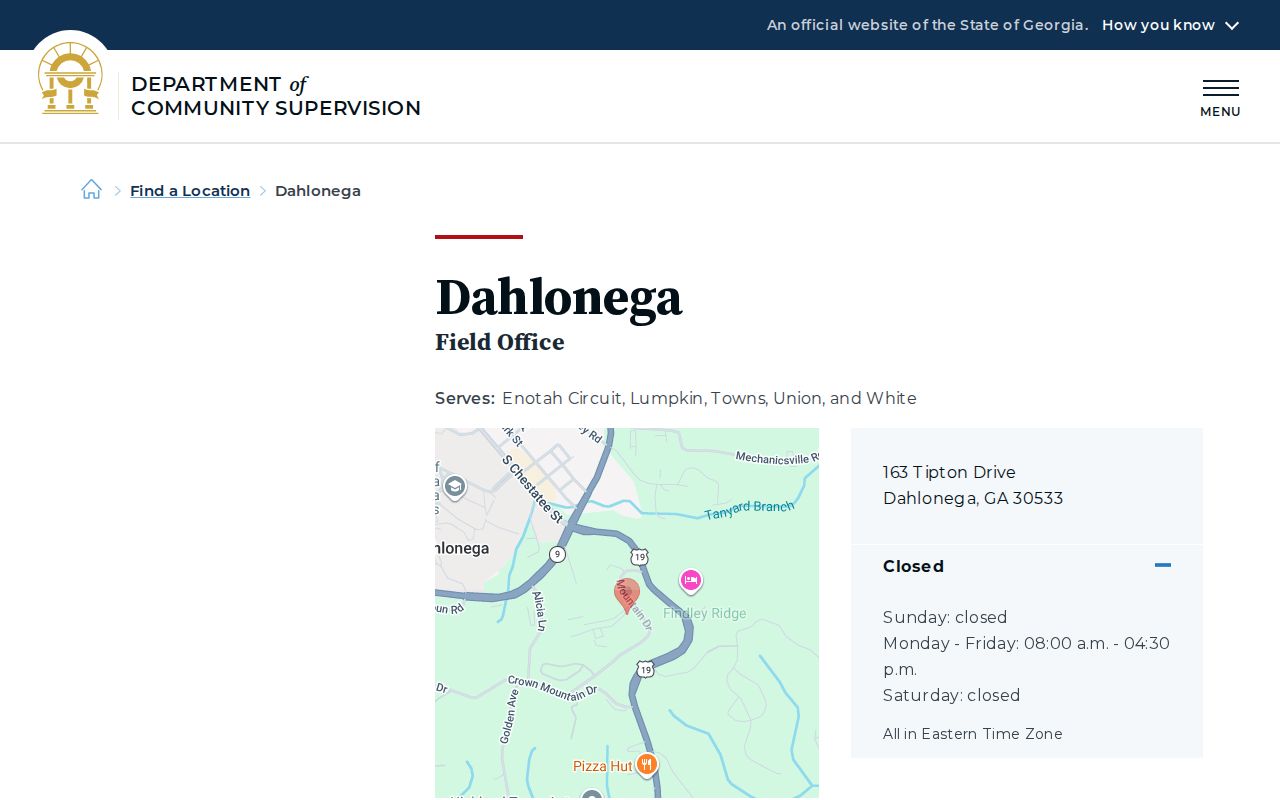
This office listing ties White County supervision to the correct DCS location rather than to the jail.
White County Supervision Violations
Conditions are the rules attached to release or a probation sentence. They can include reporting as directed, completing programs, following travel limits, and obeying court or board instructions. The exact terms come from the controlling order. A public lookup may summarize status, but it does not reproduce every condition. The court, parole board, or DCS record is the source for exact terms.
A reported violation does not by itself show the final result. An officer may investigate, a court may issue a warrant, or the parole board may review the case. “Absconder” means DCS has reported a loss of contact with the supervised person. It does not mean the person was discharged. If a warrant or revocation is at issue, confirm it through the agency or court that issued the record. VINELink may report a later custody change, but it is not a supervision docket.
When White County Supervision Ends
Supervision ends through a formal discharge, not merely because a projected end date arrives. A parole record may provide parole begin and end dates, while the board retains authority over parole status. Probation is controlled by the sentence and later court orders. Credits, revocation proceedings, amended orders, or other case action can affect the date. Obtain the discharge document or court disposition when exact proof is needed.
Georgia's public-record rules may permit a request for an existing agency record, but an office does not have to create a new explanation of a person's status. Ask for a named document, such as the discharge order, probation order, revocation order, or parole status record. Include enough identity and case information to locate it. A White County Jail release record proves the end of that jail stay; it does not prove that parole, probation, or another sentence ended.
White County Parole Review Records
Georgia's ordinary parole review is not a courtroom-style hearing where the prisoner appears before the board. The official parole process explains that the board may set a tentative parole month, deny parole, reconsider a result, or change a decision before release. For life sentences, the result is generally grant or deny rather than a tentative month.
Monthly public board meetings address agency policy and operations. They are not White County offender-case calendars, and offender cases are not decided at those meetings. The useful person-specific tools are the TPM lookup for a person still in prison and the Parolee Search after release. Parole consideration for an eligible person is not a promise of release. O.C.G.A. § 42-9-45 and offense-specific rules govern eligibility.
The parole process page captured for this project illustrates that decision path.
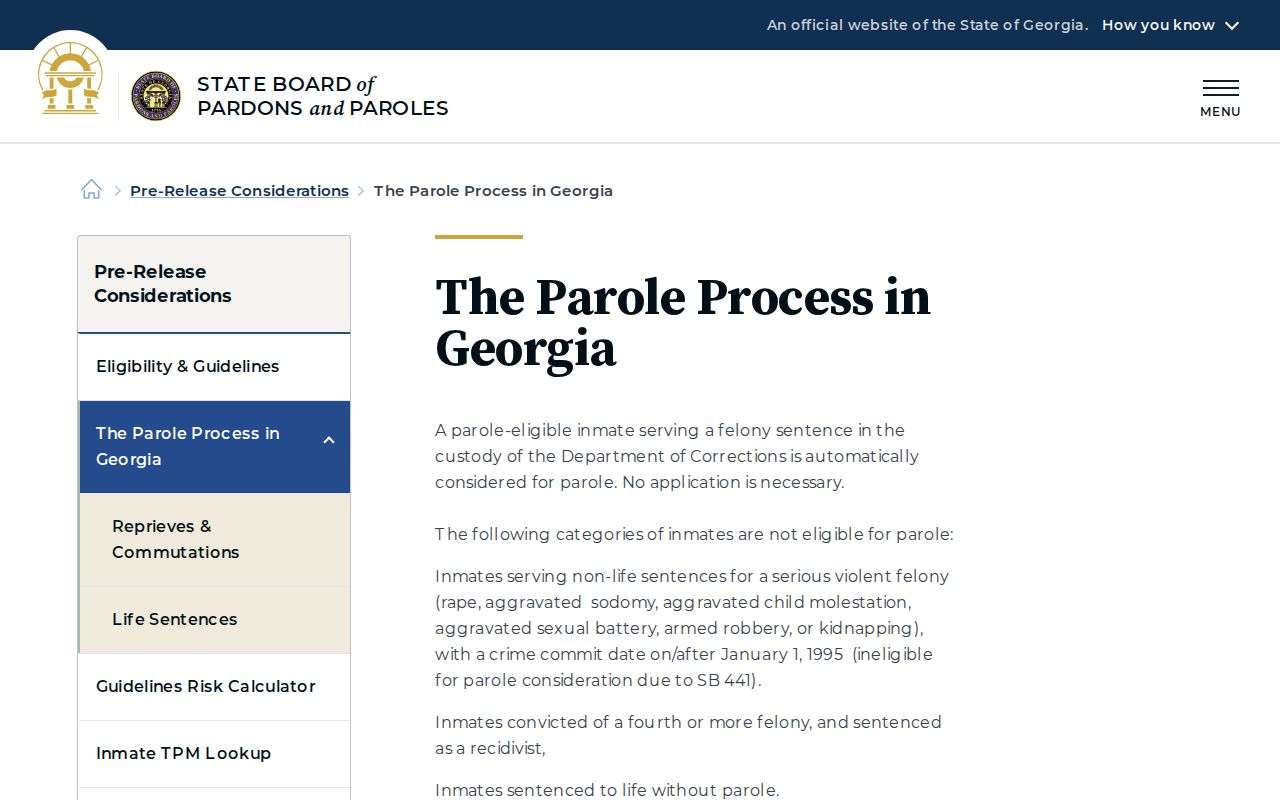
The process view helps separate a tentative review point from an actual release and active parole record.
Where White County Parolees Report
The Dahlonega assignment is the key local detail after a state release. A White County address does not guarantee that every task occurs at the county courthouse or jail. DCS organizes field supervision by service areas, and the Dahlonega office is the listed office for White County. The parole record's office field should still be checked because assignments can change.
For felony probation, pair the DCS contact with the White County sentence. For parole, pair it with the board and GDC records. That three-source check prevents a common mix-up: treating release from a building as discharge from the sentence. Release may start supervision. Discharge ends it.
Match White County Supervision Records
A reliable match uses more than a name. Start with the White County case number when the person was sentenced in Superior Court. For a state-prison record, add the GDC ID. The parole tools may list the primary offense and assigned office, while the court file can show the sentence, probation term, later modification, and revocation activity. Dates should form a sound sequence: sentence first, custody or parole next, then discharge if supervision has ended.
Different offices record different events. White County Jail documents booking and release from local custody. GDC documents state confinement. The parole board records parole review and status. DCS handles field supervision, and the court controls probation orders. A transfer can close one custody entry while another agency still holds the person. For that reason, “released” should always be tied to a named facility or sentence.
When two people share a name, compare age or date of birth when shown, the offense, county, and identifier. Do not rely on a social-media post or a single old result. If the public search is unavailable, ask the responsible office for the existing status or discharge record. State a narrow date range and the known identifier. That gives staff a better way to find the right file and reduces the risk of mixing two people.
Public parole tools show selected fields, not every internal case note. For final discharge, request the discharge record itself. For probation, use the White County court order and DCS confirmation. This keeps a projected date, active status, and completed sentence from being treated as the same event. Save the date of each search and the listed office so a later change can be compared with the prior result.